
Products
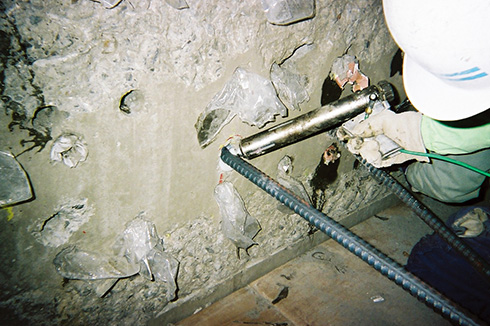
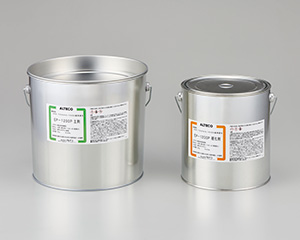
Grease-Consistent Epoxy Adhesive for Civil Engineering
Filler for Horizontal and Vertical Anchor Installation.
Joint Filler for Concrete Structures.
Sealing for Crack Injection.

Features
EP-1200P
Direct dispensing on wall.
Highly thixotropic - No sag.
No debubbling, sealing.
Cost effective than the product in cartridges.
Applicable with a cartridge gun by filling the cartridge after mixing a main part and a hardener.
Easy injection by using the rotary injector.
Works on wet surfaces.
Solvent free - no volatille components.
Minimal shrinkage after curing.
Low odor formula ensures a comfortable working environment.
Low VOC / Formaldehyde Emission
Compliant with JAIA F★★★★ and 4VOC standards – Japan’s strictest safety criteria for indoor air quality.
Suitable for use in living spaces requiring low chemical emissions.
Properties
| EP-1200P(S) Summer version | EP-1200P(W) Winter version | |||
|---|---|---|---|---|
| Base Resin | Hardener | Base Resin | Hardener | |
| Main Component | Modified Epoxy Resin | Modified Polyamine | Modified Epoxy Resin | Modified Polyamine |
| Appearance | White Grease | Pale Yellow Grease | White Grease | Brown Grease |
| Mix Ratio | 100:40 | 100:40 | ||
| Pot Life at 20℃ | 60min | 30min | ||
Cured Material Properties
| Unit | Internal Standard | Test Procedure | |
|---|---|---|---|
| Specific Gravity | 1.20±0.10 | JIS K 7112 | |
| Compressive Yield Strength | N/㎟ | ≧60 | JIS K 7181 |
| Compressive Elastic Modulus | N/㎟ | ≧1.5×10³ | JIS K 7181 |
| Bending Strength | N/㎟ | ≧50 | JIS K 7171 |
| Tensile Strength | N/㎟ | ≧30 | JIS K 7113 |
| Tensile Shear Strength | N/㎟ | ≧14 | JIS K 6850 |
| Hardness | HDD | ≧80 | JIS K 7215 |
| Impact | kJ/㎡ | ≧3.0 | JIS K 7111 |
Test temperature: 20℃
Anchor Bolt Installation Example
| Deformed Bar (D) Bolt Size (M) | Hole Diameter (㎜) | Hole Depth (㎜) | Required Resin Amount (g) | Number of Applications per Set (pcs) | Yield Point of Steel (kN) | Allowable Tensile Stress (kN) |
|---|---|---|---|---|---|---|
| D25 | 36.0 | 380 | 279 | 25 | 174.8 | 116.5 |
| D29 | 40.0 | 440 | 389 | 18 | 221.8 | 147.9 |
| D32 | 42.0 | 480 | 408 | 17 | 274.0 | 182.7 |
| D35 | 46.0 | 530 | 538 | 13 | 330.0 | 220.0 |
| D38 | 50.0 | 570 | 675 | 10 | 393.3 | 262.2 |
| D41 | 55.0 | 620 | 924 | 7 | 462.3 | 308.2 |
| D51 | 65.0 | 770 | 1430 | 4 | 699.3 | 466.2 |
| M20 | 30.0 | 300 | 199 | 35 | 57.6 | 38.4 |
| M22 | 32.0 | 320 | 231 | 30 | 71.2 | 47.5 |
| M24 | 34.0 | 340 | 271 | 25 | 83.0 | 55.3 |
| M27 | 38.0 | 380 | 369 | 18 | 107.9 | 71.9 |
| M30 | 40.0 | 400 | 400 | 17 | 131.1 | 87.9 |
| M33 | 44.0 | 440 | 523 | 13 | 163.1 | 108.7 |
| M36 | 46.0 | 460 | 559 | 12 | 192.0 | 128.0 |
●The yield point of the rebar steel is the value obtained by multiplying the nominal cross-sectional area by the reference strength of SD345, 345 N/mm².
●The yield strength of the steel for the full-thread bolt is the value obtained by multiplying the base strength of SS400, 235 N/mm², by the effective cross-sectional area.
●Do not use for items with smooth surfaces, such as round bars, which may not exhibit sufficient strength.
●The number of applications per set (pcs) is approximate.
